
Rosemary Griggs
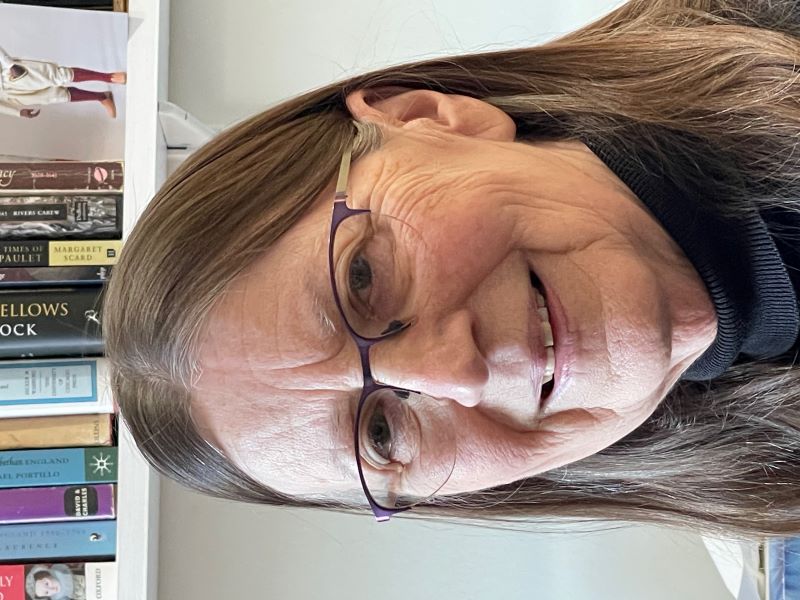
I’m lucky enough to live in beautiful Devon. This part of England boasts green rolling hills, dramatic moorland, a long coastline, chocolate-box cottages, ancient churches, and castles. Where better for me to indulge a lifelong passion for history, and discover women’s voices that are so seldom heard?
The 16th century has always held a special fascination for me. My interest in Tudor history goes back to my schooldays. I loved the tales of King Henry and his queens, Elizabeth and her courtiers. But it is the pace of change that also draws me to this era.
The invention of the printing press in the late 15th century sparked a communications revolution. Books became more widely available, and more people gained an education and could access information themselves. The scale of this change was perhaps similar to the way the Internet changed our lives during the 20th century. Social structures shifted as a well-educated middle class rose, threatening the dominance of noble and gentry landowners. On top of that, a complete upheaval in religion swept away the age-old customs and traditions that had governed everyone’s lives for generations.
I’ve spent years studying how the people of Devon coped through the Tudor years, focussing on one family — the Champernownes.
Long before they arrived in England, the Champernownes had established themselves as significant landowners in Normandy. From the 12th century onwards, they settled throughout the southwest of England, eventually giving up their foothold in France. Their landholdings and status grew through successive dynastic marriages. By the dawn of the 16th century, they were part of a powerful network of families whose influence spread far beyond the West Country. Many served at the Royal Court.
High-profile figures of this time clamour for our attention, but following the fortunes of the less well-known Champernownes has given me new insights into the turbulent Tudor world.
I found courtiers, soldiers, and seafarers who were at the forefront of the Elizabethan drive to discover new lands among the Champernowne men. As I delved into the records, it occurred to me that the names of Devon’s explorers — men like Drake and Raleigh, Hawkins and Grenville — are still well-known today. We rarely hear about the women who stood behind those famous men; wives, sisters, daughters and mothers who also lived important and interesting lives. My Daughters of Devon novels draw on my research to tell the stories of some of those forgotten women of history.
My attention was first drawn to Katherine Champernowne, Sir Walter Raleigh’s mother. She became the inspiration for my first book, A Woman of Noble Wit. The positive reaction to my debut novel has overwhelmed me. A Woman of Noble Wit gained a silver medal in the Coffee Pot Book Club Book of the Year awards for 2022, an international competition for historical fiction. In August 2024, it reached the number one spot on the Amazon Kindle charts for historical biographical fiction.
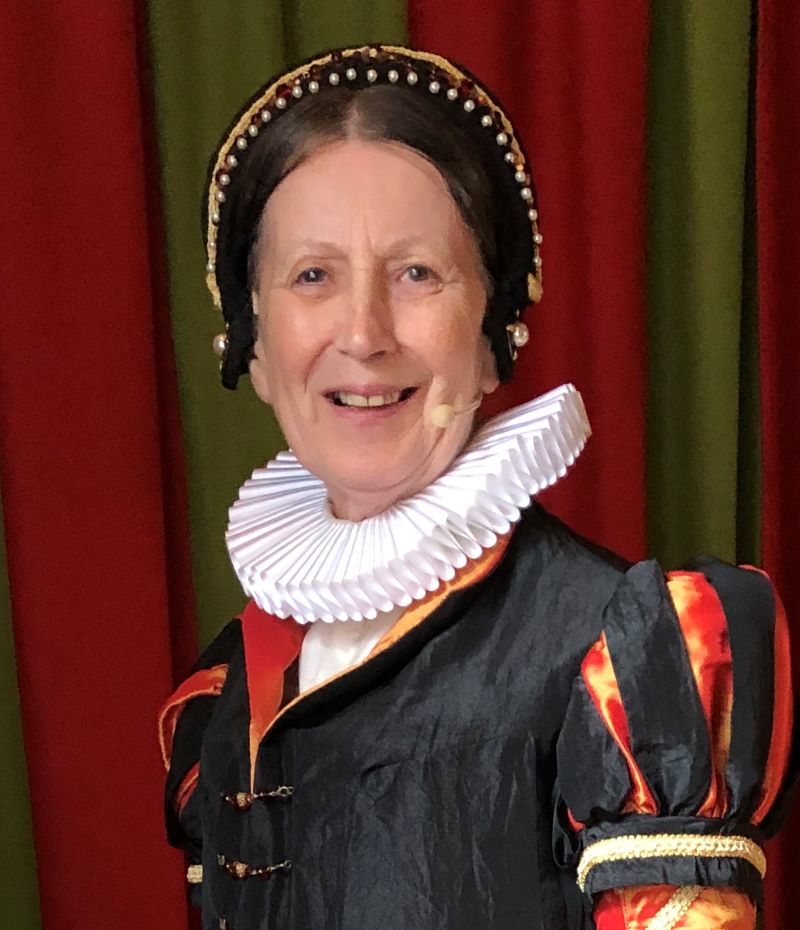
I also portray Katherine in presentations and talks for a wide range of community groups and museums. I research and create 16th century clothes, which I wear at my events. Learning about how people constructed, wore, and laundered garments, who profited from making clothing, and what fabrics they used has taken me in surprising directions. Who would think studying clothes and fashion would lead to research into politics, international trade and piracy? And of course, dressing as they did, walking in their shoes in places they knew, also brings me closer to the women I write about. It’s a vital part of my research. As the late Dame Hilary Mantle advised, I inhabit their world.
A young French Huguenot woman who married into the Champernowne family was the next to catch my eye. Lady Gabriella Roberda Montgomery, daughter of the French count who accidentally killed the king of France in a jousting accident, faced many challenges at Dartington Hall. I became so fascinated by the reception she received as an incomer, her struggle to survive a difficult marriage, secure her children’s inheritance and establish herself in Elizabethan England, that Roberda’s story runs to two volumes. I am thrilled that Mistress of Dartington Hall won a silver medal in this year’s Coffee Pot Book Club awards, while the Dartington Bride achieved a bronze in 2024.
As an author of historical fiction, I love transporting my readers to the Tudor world. However, I write about real people, and meticulous research comes first. I go back to primary sources wherever possible. When I began to map out the story of my next Champernowne woman, I hit a snag.
She is perhaps better known than my previous subjects. Those with an interest in Tudor history know her as ‘Kat Ashley.’ Many learned biographies of Queen Elizabeth mention Kat, and she has featured in films and novels. However, the character I found in my research differed from the woman historians have usually described and the one often portrayed in fiction and on screen. Before writing her fictional story, I wanted to set my findings on the record and invite a reassessment of Kat’s important contribution to Tudor history. I am thrilled that Pen and Sword Books are giving me the opportunity to publish my research. My first non-fiction work, Queen Elizabeth’s Childhood Governess, will be published on 30 August 2026.
You can keep in touch by signing up for my author newsletter or following me on social media, where I often share details of my sewing projects. And watch this space — in January 2026 I will launch ‘Notes from Devon’s Tudor Time Traveller’ on Substack, a free publication with articles and updates on my research and writing.
Events Page My Writing My Blog